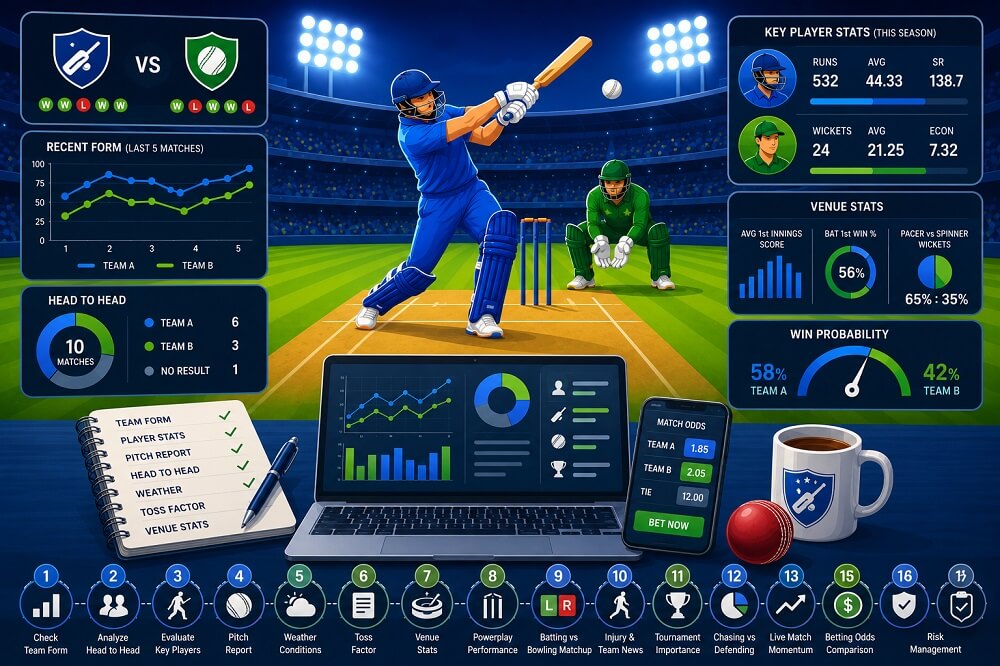
Fantasy sports platforms can display a huge amount of player information.
Recent fantasy points. Season averages. Career records. Selection percentages. Playing time. Player prices. Venue statistics. Opponent records.
For a beginner, more data does not always make a fantasy decision easier.
Sometimes it creates more confusion.
One statistic suggests Player A.
Another number appears to support Player B.
A social media post recommends Player C because of a historical record.
Eventually, the fantasy lineup is selected using whichever statistic looked most impressive at the time.
Learning how to analyze player statistics for fantasy sports is not about collecting every number available.
It is about understanding what a statistic measures, why it may be relevant, and what limitations exist in the data.
A player average does not guarantee the next fantasy score.
A strong historical record does not force the next sporting event to produce the same result.
Recent form can change quickly.
Player roles, team structure, participation, and sporting conditions can also affect the context behind statistics.
The goal of fantasy player analysis is therefore not certainty.
The goal is to use data more carefully.
This beginner guide explains a practical way to study fantasy sports statistics in 2026 without becoming overwhelmed by numbers, with helpful insights and resources from play99exch.
What Is Player Statistical Analysis in Fantasy Sports?
Player statistical analysis is the process of reviewing sporting and fantasy data to better understand an athlete’s previous performances and current playing context.
The important word is understand.
Statistics describe events that have already happened.
They can identify patterns.
They can help compare players.
They may show changes in participation or performance.
However, statistics do not control the next real-world sporting event.
Imagine a player has scored more than 50 fantasy points in five consecutive events.
That is useful historical information.
It does not mean the athlete is guaranteed to score more than 50 fantasy points next time.
A good fantasy analysis separates two ideas:
What the data shows
and
What you expect might happen
The first can be based on historical information.
The second contains uncertainty.
Keeping this distinction clear is one of the most important habits in fantasy sports research.
Why Are Player Statistics Important in Fantasy Sports?
Fantasy scoring is connected to real sporting actions.
Player statistics can help explain how regularly athletes have recorded those actions.
Suppose a fantasy scoring system rewards several types of contributions.
Looking only at total fantasy points tells you the final result.
Reviewing the underlying player statistics can help explain where those fantasy points came from.
This matters because two players with similar fantasy averages may have very different performance profiles.
One athlete may regularly contribute across several scoring categories.
Another may depend heavily on occasional major performances.
Neither player is automatically better.
The statistics simply provide more context.
When used properly, player data can help you compare roles, recent involvement, scoring patterns, and performance consistency.
1. Read the Fantasy Scoring Rules Before Studying Statistics
This should be the first step.
A statistic is useful for fantasy research only when you understand its connection to the fantasy scoring system.
Different fantasy games can use different scoring rules.
Even fantasy platforms covering the same sport may award points differently.
Before opening a player statistics page, check which sporting actions earn fantasy points.
Review bonus conditions.
Understand deductions.
Check whether scoring differs according to player position or role.
Also review captain and vice-captain multiplier rules where applicable.
Once you understand the scoring system, player statistics become easier to prioritize.
You can focus on data connected to eligible fantasy scoring actions.
Without this step, you may spend time studying an impressive sporting statistic that has limited relevance to the fantasy game’s scoring rules.
2. Start With Recent Participation
Before studying advanced performance data, check whether the athlete has actually been participating.
Look at several recent sporting events.
Depending on the sport, participation information may include starts, appearances, minutes, batting involvement, bowling opportunities, or other role-specific measures.
Ask:
Has the player participated regularly?
Has involvement increased?
Has playing time decreased?
Were recent events missed?
Is the athlete returning after an absence?
Participation statistics create context for performance data.
For example, a player’s recent average may have declined.
That could reflect poorer sporting performance.
It could also be connected to reduced playing opportunities.
The statistic alone does not explain the reason.
Start with participation and then investigate performance.
3. Review Several Recent Performances
One fantasy score should rarely become your entire player analysis.
Beginners often react strongly to the previous event.
A player scores 120 fantasy points and immediately becomes an important selection option.
Another athlete scores 10 points and is quickly removed from consideration.
A better approach is to review several recent performances.
Consider a fictional scoring sequence:
35, 42, 39, 44, and 118.
The 118-point performance is important.
However, it is noticeably different from the previous four results.
This creates a research question.
Why did the player’s score increase?
Perhaps the athlete’s role changed.
Maybe playing opportunities increased.
A particular fantasy bonus may have affected the total.
The player could also have produced an exceptional sporting performance.
Reviewing several events helps you identify patterns and unusual results.
4. Do Not Confuse Recent Form With a Guarantee
Recent form is one of the most discussed fantasy sports statistics.
It is also commonly misunderstood.
Strong recent form means the player has performed well during a recent period.
It does not mean the athlete must perform well in the next event.
Likewise, poor recent statistics do not make a future strong performance impossible.
Use recent form to understand what has happened.
Then investigate the current context.
Has the player’s role remained stable?
Are participation opportunities similar?
Has the team structure changed?
Is the upcoming sporting format the same?
Recent form is useful because it provides current historical information.
The phrase may sound contradictory, but all performance statistics describe the past.
Use recent data carefully and avoid turning a pattern into certainty.
5. Understand Fantasy Point Averages
Fantasy point averages provide a quick summary of previous scoring.
Suppose a player averages 60 fantasy points.
What does that number actually tell you?
The answer depends on the calculation period.
Is it a season average?
A career average?
An average from the previous five events?
Different periods can produce different numbers.
You should also examine the individual performances behind the average.
Consider two fictional players.
Player A scores:
58, 62, 60, 64, and 56.
Player B scores:
10, 15, 180, 12, and 20.
The averages summarize both scoring patterns.
However, the individual results reveal very different performance profiles.
Never use an average without checking the data behind it when that information is available.
An average is a starting point for research.
It should not always be the final conclusion.
6. Look at Median Performance When Available
The median is another useful statistical concept.
To find the median, arrange a group of values in order and identify the middle value.
Consider these fictional fantasy scores:
10, 15, 20, 25, 180.
The average is strongly influenced by the 180-point performance.
The median is 20.
The median does not replace the average.
It provides another view of the data.
For players with highly variable fantasy scores, comparing average and median performance may reveal whether a few exceptional results are influencing the average.
Beginners do not need to calculate advanced statistics for every athlete.
However, understanding basic concepts such as average and median can improve fantasy data interpretation.
The important question is not simply:
Which player’s number is higher?
Ask:
What performances created this number?
7. Study Consistency
Consistency describes how stable a player’s performance pattern appears across a selected period.
Imagine two fictional athletes.
Player A:
52, 55, 49, 58, 54.
Player B:
5, 110, 12, 95, 8.
Player A has shown a more stable recent scoring range.
Player B has shown much greater variation.
This does not prove Player A will score more fantasy points in the next event.
It simply identifies different recent scoring patterns.
When reviewing consistency, check the time period and number of events.
Five performances provide limited information compared with a much larger sample.
Player roles may also change during the period.
Use consistency as a descriptive concept.
Avoid treating it as a guarantee of future performance.
8. Identify High-Variation Player Profiles
Some players naturally produce more variable fantasy scores.
Their strongest fantasy performances may depend on sporting actions that do not occur regularly.
Other athletes may contribute through several categories.
When reviewing a high-variation player, ask why the fantasy scores move significantly between events.
Look at the point breakdown.
Was the player receiving similar opportunities?
Did one major sporting contribution create most of the fantasy points?
Were bonuses involved?
Did the athlete’s role change?
Variation is not automatically negative.
A high-variation player can produce an exceptional fantasy score.
The purpose of statistical analysis is to understand the profile.
Once you know why the scores vary, you can compare the athlete with other fantasy options more clearly.
9. Study the Fantasy Point Breakdown
Total fantasy points are convenient.
Point breakdowns are often more informative.
Suppose a player scores 90 fantasy points.
Where did the points come from?
Did the athlete contribute across several categories?
Was one major sporting action responsible for most of the total?
Were bonus points significant?
Did deductions affect the score?
Reviewing the fantasy point breakdown helps connect real-world performance with fantasy scoring.
This can also reveal whether recent high scores came from similar contribution patterns.
Imagine a player has recorded three strong fantasy performances.
In every event, the points were generated in completely different ways.
That may describe a different player profile from an athlete who repeatedly contributes through the same scoring categories.
Neither pattern guarantees future points.
The breakdown simply provides better context.
10. Understand the Player’s Current Role
Statistics can become misleading when a player’s role changes.
Suppose an athlete has excellent season-long fantasy numbers.
Most of those points were recorded while performing a particular role.
Recently, the real team has changed its structure.
The player now receives different responsibilities.
The season statistics remain mathematically correct.
However, they may not perfectly describe the player’s current opportunities.
This is why fantasy analysis should connect numbers with sporting roles.
Ask:
Where is the athlete currently playing?
How regularly are they involved?
Have responsibilities increased or decreased?
Is the current role similar to the role behind the historical statistics?
Data without role context can create incomplete conclusions.
Always try to understand the sporting situation behind the numbers.
11. Compare Statistics From the Same Sporting Format
Many sports use different competition formats.
Player performance can vary between formats.
The rules, duration, pace, tactics, and team roles may be different.
Before comparing players, confirm that the statistics come from a relevant sporting format.
Do not automatically combine every career statistic.
Ask which competition the data covers.
Check whether the fantasy scoring system is the same.
Review whether the player’s role changes between formats.
A large historical data set is not automatically more useful if much of the information comes from a different sporting context.
Try to compare relevant statistics.
The closer the data matches the upcoming event, the easier it is to understand the current context.
12. Pay Attention to Sample Size
Sample size is the number of observations included in a statistic.
This is an essential fantasy research concept.
Suppose a player has an average of 100 fantasy points against a particular opponent.
That sounds impressive.
Then you discover the player has faced the opponent once.
The average is based on a single performance.
Now consider another athlete with an average based on 30 events.
The two statistics should not be interpreted in the same way.
Small samples can produce extreme numbers.
This does not make the data useless.
It means the information has greater limitations.
Whenever you see an impressive statistic, ask:
How many performances are included?
This simple question can prevent many fantasy analysis mistakes.
13. Check the Time Period Behind the Statistics
A player statistic can be accurate and still have limited relevance to the current situation.
Consider a strong venue record built over eight years.
During that time, the athlete’s role may have changed several times.
The real team may use a different tactical system.
The player’s sporting responsibilities could be completely different.
When reviewing statistics, check the dates.
Recent data may better reflect the player’s current role.
Older data can still provide historical context.
The goal is not to automatically reject old statistics.
It is to understand what period the number describes.
Fantasy analysis becomes more useful when the time period is clearly identified.
Avoid combining old and current performance information without considering role changes.
14. Use Per-Opportunity Statistics Carefully
Raw totals can be influenced by participation.
A player who receives more playing opportunities may naturally accumulate larger statistical totals.
Depending on the sport, per-minute, per-appearance, per-attempt, or other opportunity-based statistics can provide additional context.
These measures can help compare player efficiency or involvement.
However, they also have limitations.
A player with excellent per-minute statistics may receive limited playing time.
An athlete with a small number of opportunities may produce an unusually high rate that becomes difficult to maintain across a larger sample.
Use per-opportunity statistics alongside actual participation.
Ask both:
What does the player do when involved?
and
How much involvement does the player normally receive?
Both questions can matter in fantasy research.
15. Do Not Use Selection Percentage as a Performance Statistic
Selection percentage shows fantasy user behavior.
It does not measure sporting performance.
A highly selected player may be popular because of recent form.
The athlete may also be famous.
A previous major fantasy score could influence user choices.
Online recommendations may affect selection patterns.
None of these factors determines what happens in the real sporting event.
Likewise, a player with a low selection percentage is not automatically a hidden high-performing option.
Use selection percentage only for what it actually measures.
It tells you how fantasy users are selecting players within the platform.
Do not confuse popularity data with player performance data.
Research the athlete separately.
16. Compare Players Using the Same Statistical Period
Player comparisons can become misleading when different time periods are used.
Suppose you compare Player A’s previous five events with Player B’s full-season statistics.
The numbers describe different periods.
A better comparison uses similar data where practical.
Compare recent form across the same number of events.
Review statistics from the same sporting format.
Check similar participation measures.
Consider current player roles.
A simple comparison table may help:
| Research Factor |
Player A |
Player B |
| Recent events reviewed |
5 |
5 |
| Participation |
Regular |
Regular |
| Current role |
Stable |
Recently changed |
| Recent fantasy pattern |
Consistent |
Variable |
| Scoring categories |
Multiple |
Concentrated |
| Sample limitation |
Small recent sample |
Small recent sample |
The table does not predict the better performer.
It creates a more consistent comparison.
17. Look for Role Changes Behind Statistical Trends
A rising fantasy scoring trend can attract attention.
Suppose a player’s recent fantasy scores are:
22, 28, 40, 55, and 70.
The numbers show improvement.
Now ask why.
Did playing time increase?
Did the athlete move into a different role?
Has a teammate’s absence created additional opportunities?
Did the scoring increase because of several unusual sporting events?
A statistical trend becomes more informative when you understand the reason behind it.
The same process applies to declining numbers.
A player may appear to be in poor form.
Perhaps their role has changed.
Maybe participation opportunities have decreased.
Statistics identify the trend.
Sporting research helps explain it.
18. Avoid Searching Only for Statistics That Support Your Player
This is a form of confirmation bias.
You decide that Player A should be in your fantasy team.
Then you search for positive statistics about the athlete.
Strong venue record?
Save it.
Good historical performance against the opponent?
Remember it.
Recent poor performances?
Ignore them.
This creates an unbalanced research process.
Instead, actively look for information that could challenge your original view.
Check recent participation.
Review the current role.
Look at the complete performance sequence.
Examine sample sizes.
Consider team changes.
The objective is not to prove your first opinion correct.
The objective is to understand the player.
If new information changes your view, update the fantasy analysis.
19. Do Not Add More Statistics Just to Look Advanced
Fantasy research does not become better simply because it contains more numbers.
Beginners sometimes collect dozens of statistics.
Eventually, the data becomes difficult to interpret.
Start with a small group of relevant information.
For example:
Recent participation.
Current role.
Recent fantasy scores.
Fantasy point breakdown.
Playing opportunities.
Relevant opponent or venue context.
These factors may already provide enough information for a basic player comparison.
Advanced metrics can be added when you understand their definitions and limitations.
Do not use a statistic simply because the name sounds technical.
If you cannot explain what a metric measures, research the definition before using it in a fantasy decision.
Simple data understood properly is generally more useful than complicated data used incorrectly.
20. Separate Correlation From Cause
Two events happening together does not automatically mean one caused the other.
Suppose a player has produced strong fantasy scores in night events.
It may be tempting to conclude that night conditions cause better performances.
But other factors could be involved.
The opponent may have been different.
The player’s role could have changed.
The sample might be small.
The athlete may simply have produced several strong performances during those events.
Fantasy analysis should be careful with cause-and-effect claims.
When you notice a statistical pattern, ask whether there is a logical sporting explanation.
Then look for additional evidence.
Avoid turning random historical patterns into selection rules.
Statistics can reveal relationships.
Understanding why those relationships appear requires context.
21. Create a Simple Player Statistics Sheet
You do not need expensive analytics software to organize beginner fantasy research.
A simple spreadsheet or note can be enough.
For each shortlisted player, record:
Expected participation
Current role
Recent fantasy scores
Recent involvement
Main fantasy scoring categories
Relevant role changes
Sample size notes
Upcoming match context
Keep the information simple.
The purpose is not to build a professional sporting model.
You are creating a consistent player-comparison process.
Using the same research categories can reduce the tendency to select one player from recent form and another entirely from reputation.
A simple sheet also makes post-event review easier.
You can return to the original information and check whether your assumptions were reasonable.
22. Record Why You Selected a Player
After completing your statistical analysis, write one sentence about each important fantasy selection.
For example:
“Selected because of regular recent participation, a stable current role, and contributions across several fantasy scoring categories.”
Another player may have a completely different reason.
The sentence forces you to summarize the research.
If your explanation is:
“Scored 100 points last time,”
you may want to investigate further.
If the explanation is:
“Everyone is selecting this player,”
you are using popularity rather than player performance analysis.
A clear selection note helps reveal weak reasoning before the fantasy deadline.
It can also improve your post-event review.
23. Review Statistical Predictions After the Sporting Event
After the event, compare your assumptions with what actually happened.
Do not review only the final fantasy points.
Check the player role.
Did the athlete receive the expected opportunities?
Was participation similar to recent events?
Did the team use the player differently?
Were your statistics relevant to the sporting format?
Did a small sample influence your decision too strongly?
The objective is not to criticize every incorrect expectation.
Real sporting events are unpredictable.
Instead, look for repeated research errors.
If you repeatedly misunderstand player roles, improve role research.
If averages regularly mislead your selections, study the individual scoring distributions.
Fantasy learning becomes more useful when you identify specific weaknesses in your analysis.
A Simple Fantasy Player Statistics Framework
Beginners can use the S-A-R-O-S framework.
S — Scoring: Which player statistics connect directly to the fantasy scoring system?
A — Average and pattern: What do the average and individual recent performances show?
R — Role: Is the player’s current sporting role consistent with the historical data?
O — Opportunity: How regularly does the athlete receive opportunities to record fantasy scoring actions?
S — Sample size: How many sporting events are included in the statistics?
After these five checks, review the upcoming match context and current team news.
The framework cannot predict exact fantasy points.
It simply creates a repeatable method for interpreting player data.
Common Fantasy Statistics Analysis Mistakes
A common mistake is using one recent fantasy score as a complete player analysis.
Beginners may also rely entirely on averages without reviewing individual performances.
Small samples are frequently ignored.
Statistics from different sporting formats can be compared incorrectly.
Another mistake is using historical numbers without checking whether the player’s role has changed.
Some users confuse fantasy selection percentage with sporting performance.
Others collect advanced metrics without understanding what the numbers measure.
The solution is not to stop using statistics.
Use fewer numbers more carefully.
Understand the definition, period, sample, and sporting context behind the data.
Fantasy Player Statistics Checklist
Before using player data in a fantasy decision, check the following:
Have I read the current fantasy scoring rules?
Does this statistic connect to fantasy scoring?
Have I checked recent participation?
Did I review several recent performances?
Am I overreacting to one fantasy score?
Do I understand the player’s average?
Have I looked at the individual scores behind the average?
Is the player showing a stable or variable scoring pattern?
Did I review the fantasy point breakdown?
Do I understand the current player role?
Is the data from the correct sporting format?
Have I checked the sample size?
Do I know the time period covered?
Am I comparing players using similar periods?
Have recent role changes affected the statistics?
Am I confusing selection percentage with performance?
Am I searching only for positive player statistics?
Do I understand every advanced metric I am using?
Have I separated statistical patterns from guaranteed predictions?
Can I explain my player selection in one sentence?
This checklist cannot remove uncertainty from fantasy sports.
It can help you use player data more consistently.
Responsible Fantasy Sports Participation
Fantasy sports should be treated as entertainment and a form of engagement with sporting statistics.
Users should follow platform age requirements and applicable local rules.
Younger sports fans can use free-to-play, hypothetical, or educational fantasy formats to practice player comparisons and basic statistical analysis without participating in paid contests.
Player statistics cannot guarantee a fantasy result.
Historical data describes previous sporting performances.
The next real-world event remains uncertain.
Be cautious of statistical systems or fantasy content claiming guaranteed players, certain captain selections, or risk-free results.
A useful statistical process explains both the information and its limitations.
Final Thoughts
Learning how to analyze player statistics for fantasy sports begins with asking better questions about the data.
Do not look only for the largest number.
Understand what the statistic measures.
Check the time period.
Review the sample size.
Study the individual performances behind averages.
Start with recent participation and current player roles.
Then examine fantasy scoring patterns and point breakdowns.
Compare players using similar periods and sporting formats.
When a statistical trend appears, investigate the reason behind it.
A player’s fantasy scores may improve because their role has expanded.
Declining numbers could be connected to reduced opportunities.
Sometimes a major fantasy score is simply an exceptional sporting performance.
Avoid using selection percentage as a player-performance statistic.
Do not collect technical metrics only to make your fantasy analysis appear advanced.
Use data you understand.
Keep a simple player research sheet and record the reasons behind important selections.
After the sporting event, review whether your understanding of participation, role, and opportunities was accurate.
Statistics cannot tell you exactly what will happen next.
No average, trend, venue record, or historical matchup guarantees future fantasy points.
The value of player data is context.
It helps you understand previous performances.
It allows more consistent comparisons.
It can reveal changes worth researching.
Study the numbers.
Understand the role behind them.
Check the sample.
Compare the context.
Then make your fantasy lineup decisions for reasons you can clearly explain.
Frequently Asked Questions
How do I analyze player statistics for fantasy sports?
Start with the fantasy scoring rules, review recent player participation, compare several performances, study fantasy point breakdowns, understand current roles, and check the sample size and time period behind statistics.
Are fantasy point averages useful?
Yes. Fantasy point averages can summarize previous scoring, but users should review the individual performances behind the average because exceptional results can significantly influence the number.
How many recent matches should I analyze for fantasy sports?
There is no universal number for every sport or fantasy format. Review several relevant recent events and clearly understand the sample size, sporting format, and any player role changes.
What does consistency mean in fantasy sports?
Consistency describes how stable a player’s fantasy scoring pattern appears across a selected period. It provides historical context but does not guarantee a similar future performance.
Is selection percentage a player performance statistic?
No. Selection percentage measures fantasy user behavior and popularity within a platform. It does not measure what an athlete will do in the upcoming sporting event.
Can player statistics guarantee fantasy sports results?
No. Statistics can identify historical patterns and support player comparisons, but real sporting performances and future fantasy outcomes remain unpredictable.