T20 Match Prediction: 10 Key Factors That Influence the Winner

T20 cricket is one of the most unpredictable formats in the sport. With only 20 overs per innings, a match can change direction within a few deliveries. One powerful batting partnership, a quick spell of wickets or an outstanding final over can completely alter the result.

That is why a good T20 match prediction should consider more than just which team looks stronger on paper.

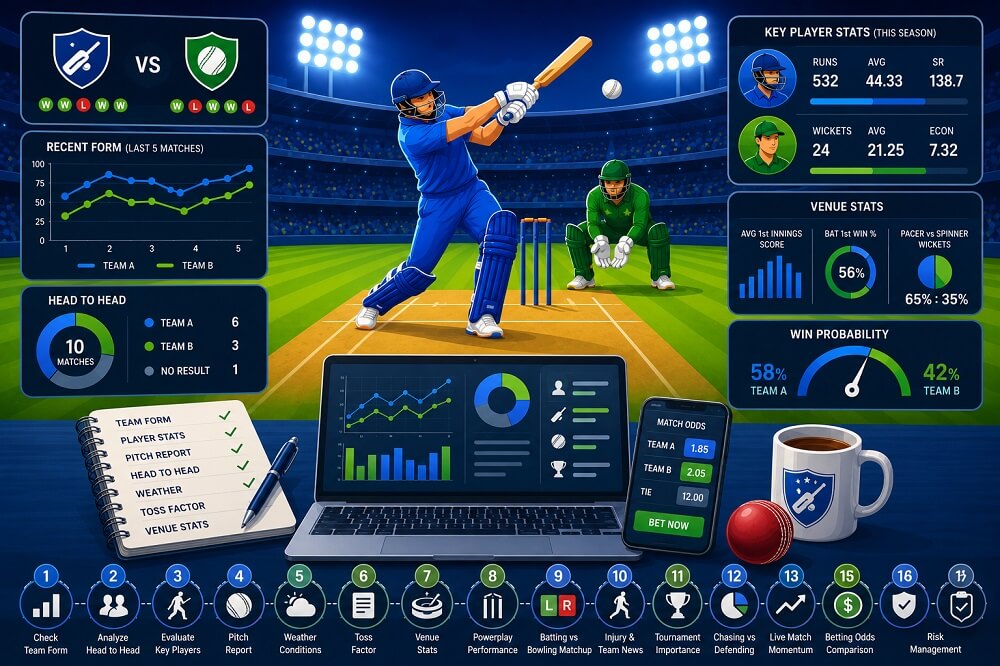
Team form, player performance, pitch conditions, weather, toss results, venue statistics, batting depth and bowling strength can all influence the balance of a T20 match.

In this guide, we explore 10 important factors that can influence a T20 match result and explain how they can be used for better cricket analysis, while also providing useful context for readers interested in Play99Exch and T20 match statistics.

10 Important Factors to Consider in T20 Match Prediction

1. Recent Team Form

Recent form is one of the first things to examine when analyzing a T20 match.

A team’s overall record provides useful information, but recent performances can reveal more about its current momentum.

Look at:

  • Results from recent matches
  • Batting performances
  • Bowling performances
  • Run margins
  • Wicket margins
  • Performance against strong opponents
  • Consistency across recent games

However, recent form should not be considered in isolation. A team may have won several matches against weaker opponents, while another may have performed well against much stronger teams.

2. Top-Order Batting Strength

T20 matches often place significant pressure on the opening batters and top order.

A strong opening partnership can provide:

  • A fast powerplay
  • A solid foundation
  • More flexibility for the middle order
  • Pressure on the opposition bowlers

When analyzing a T20 match, consider the form and consistency of the opening batters as well as their ability to score quickly during the powerplay.

Strike rate is useful, but it should be considered alongside consistency, dismissal patterns and opposition bowling quality.

3. Middle-Order and Finishing Ability

A team does not win a T20 match only through its opening batters.

The middle order and finishers become particularly important during the final overs.

Useful factors include:

  • Finishing experience
  • Boundary-scoring ability
  • Ability to rotate strike
  • Performance under pressure
  • Batting depth
  • Experience against different bowling styles

A team with several reliable scoring options may be better equipped to recover from early wickets or accelerate during the final five overs.

4. Bowling Attack

Bowling quality is just as important as batting strength.

A T20 prediction should examine the complete bowling attack rather than focusing only on one star bowler.

Important areas include:

  • Powerplay bowling
  • Middle-over control
  • Death-over bowling
  • Wicket-taking ability
  • Economy rate
  • Spin options
  • Pace variations
  • Bowling depth

Death bowling can be particularly important because the final overs often produce a large number of runs.

A team with reliable bowlers for the final overs may have an advantage when defending a competitive total.

5. Player Form and Availability

Individual player performance can have a major impact on a short-format match.

Before making a prediction, check:

  • Recent batting form
  • Recent bowling form
  • Player fitness
  • Injuries
  • Selection changes
  • Expected playing XI
  • Role within the team

A key player missing from the lineup can change the team’s balance.

At the same time, one player’s absence does not automatically mean the team will lose. Strong replacement options and team depth can reduce the impact.

6. Pitch and Ground Conditions

The venue can significantly influence T20 match analysis.

Some grounds tend to produce high-scoring matches, while others may offer more assistance to bowlers.

Important considerations include:

  • Average first-innings score
  • Boundary dimensions
  • Pitch behavior
  • Pace and bounce
  • Spin assistance
  • Historical scoring patterns
  • Recent matches at the venue

For example, a small ground with short boundaries may create more opportunities for sixes, while a slower surface may make stroke-making more difficult.

Historical venue statistics should be used as context rather than treated as a guarantee of what will happen in the next match.

7. Toss and Batting First

The toss can influence match strategy, particularly at certain venues and under specific weather conditions.

Captains may choose to bat first or chase depending on:

  • Pitch behavior
  • Dew expectations
  • Weather
  • Historical venue trends
  • Strength of the batting lineup
  • Quality of the bowling attack

However, the toss alone should not determine a prediction.

Its importance depends on the conditions and the teams involved.

8. Head-to-Head Record

Head-to-head statistics can provide additional context.

You can examine:

  • Previous meetings
  • Recent results between the teams
  • Performance at the same venue
  • Batting matchups
  • Bowling matchups

But historical head-to-head records should be interpreted carefully.

A team that dominated several seasons ago may have a completely different squad today. Player changes, coaching changes and changing team strategies can make old results less relevant.

9. Weather and Match Conditions

Weather can influence T20 cricket in several ways.

Before a match, analysts may check:

  • Rain probability
  • Humidity
  • Temperature
  • Wind
  • Dew
  • Possibility of interruptions

Dew can sometimes make bowling and fielding more difficult during the second innings, while rain can reduce the number of overs and dramatically change the strategic situation.

Weather therefore belongs in the broader match-analysis process.

10. Live Match Situation

Pre-match analysis is only part of T20 prediction.

Once the match begins, the current situation becomes extremely important.

During a live match, useful indicators include:

  • Current score
  • Wickets lost
  • Overs completed
  • Current run rate
  • Required run rate
  • Balls remaining
  • Batters at the crease
  • Bowlers remaining
  • Partnership strength

For example, a team chasing 180 at 100/2 after 12 overs is in a very different position from a team at 100/6 after 12 overs.

This is why live T20 match prediction can change significantly after a single over or wicket.

How Win Probability Fits Into T20 Prediction

Win probability is a useful way to express the changing balance of a match.

A statistical model can combine factors such as score, wickets, balls remaining, required run rate, player quality and historical data to estimate the probability of each team winning.

For example:

Team A: 68%
Team B: 32%

This means the model considers Team A more likely to win at that particular moment. It does not mean Team A is guaranteed to win.

A wicket, six, dropped catch or expensive over can change the probability quickly.

Simple T20 Match Prediction Checklist

Before analyzing a T20 match, consider:

  • Recent team form
  • Top-order batting
  • Middle-order depth
  • Finishing ability
  • Bowling attack
  • Death-over bowling
  • Player availability
  • Pitch conditions
  • Venue statistics
  • Toss and weather
  • Head-to-head data
  • Live match situation

Using several factors together is generally more informative than relying on a single statistic.

Common Mistakes in T20 Match Prediction

Looking Only at the Last Match

One outstanding performance does not necessarily mean a team will repeat it.

Ignoring the Playing XI

A prediction made before the final lineup is announced may become outdated when key players are unavailable.

Overvaluing Head-to-Head Records

Old matches may involve completely different players and team combinations.

Ignoring Venue Conditions

The same team can perform differently depending on the pitch and ground.

Treating Predictions as Guarantees

Even the strongest statistical model cannot remove the uncertainty from cricket.

Can T20 Match Prediction Be 100% Accurate?

No.

T20 cricket contains too much uncertainty for any prediction system to guarantee the result.

A statistical model can estimate probabilities based on available information, but unexpected events can always change the match.

The purpose of prediction is therefore to analyze probabilities and relevant factors, not to promise a particular outcome.

Frequently Asked Questions

What is T20 match prediction?

T20 match prediction is the process of analyzing teams, players, statistics, conditions and other information to estimate which team has a stronger chance of winning a T20 match.

What is the most important factor in T20 prediction?

There is no single factor that always determines the result. Team form, player availability, batting strength, bowling quality, pitch conditions and the live match situation can all be important.

Does the toss affect T20 match prediction?

It can. The effect depends on the venue, pitch, weather, dew and the strengths of the two teams.

How important is the pitch?

Pitch conditions can have a significant impact because they influence batting, pace bowling, spin and scoring rates.

Can player form change a T20 prediction?

Yes. T20 matches are short, so the performance of one or two key players can have a substantial impact on the outcome.

Is live T20 prediction different from pre-match prediction?

Yes. Live prediction can incorporate the actual score, wickets, balls remaining, required run rate and current players on the field, while pre-match analysis relies primarily on information available before the game.

Final Thoughts

A strong T20 match prediction requires more than simply choosing the team with the better reputation.

Recent form, batting depth, bowling quality, player availability, pitch conditions, venue statistics, weather, toss and live match data can all contribute to a more complete analysis.

Most importantly, predictions should be treated as probability-based analysis rather than guaranteed results. Cricket win probability helps explain how likely each team is to win based on factors such as the current score, wickets, balls remaining, required run rate, player performance and match conditions. T20 cricket moves quickly, and one over can completely change the balance of a match, which is why live **Cricket Win Probability** can change significantly throughout the game.

By considering multiple factors together, cricket fans can develop a more informed understanding of what may influence the outcome of a T20 game.

Cricket Win Probability Explained: How Today’s Match Prediction Is Calculated

If you have watched a live cricket match, you have probably seen a graphic showing something like Team A 72% — Team B 28%. But what does that percentage actually mean?

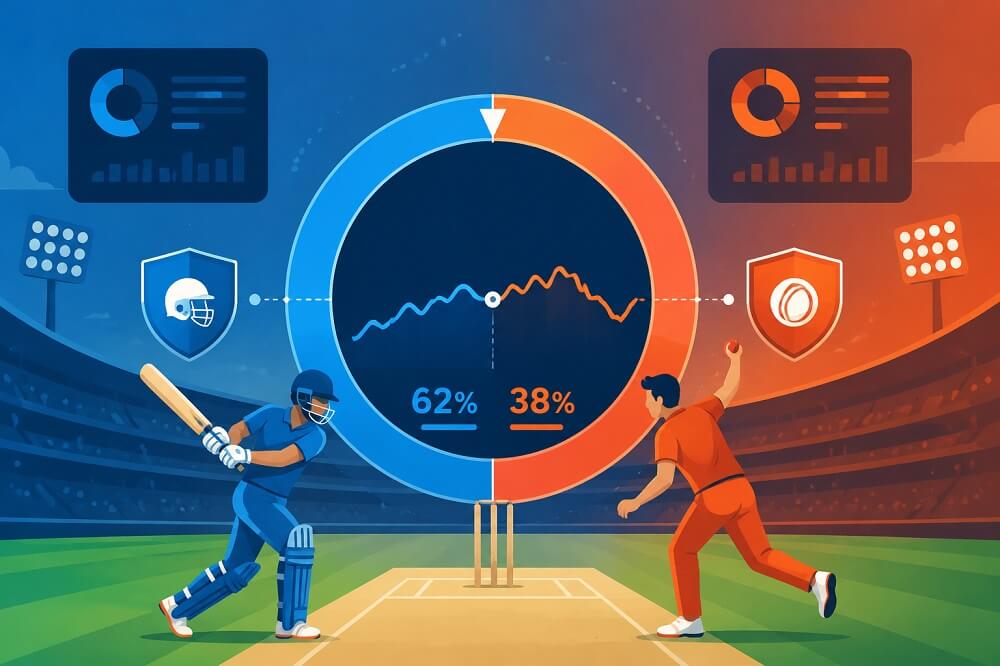
Cricket win probability is a statistical estimate of how likely each team is to win from a particular point in the match. Unlike a simple prediction that says who is expected to win, a probability model measures the strength of both possible outcomes.

The number can change after almost every delivery. A wicket, boundary, dropped catch, change in required run rate or even a shift in match conditions can move the calculation.

Modern cricket analytics models use historical match data, current score, wickets, balls remaining, player strength, venue characteristics and other match conditions to estimate win probability. Advanced systems may simulate the remaining balls thousands of times to calculate how often each team is expected to win. For users searching Play99Exch cricket predictions and match win probability, these statistics can provide useful context when evaluating a live match.

What Is Cricket Win Probability?

Cricket win probability represents the estimated chance that a team will eventually win the match given the information available at that moment.

For example:

  • Team A: 70%
  • Team B: 30%

This does not mean Team A is guaranteed to win. It means that, among situations the model considers similar, Team A is estimated to win approximately 70% of the time.

That distinction is important. A team with a 75% win probability can still lose. Probability measures likelihood, not certainty.

How Is Cricket Win Probability Calculated?

There is no single universal formula used by every cricket website, broadcaster or analytics provider. Different models use different datasets, algorithms and variables.

A typical model follows several steps:

1. Collect Historical Cricket Data

The model first learns from large amounts of previous match data.

Depending on the format, this can include:

  • Match results
  • Team strength
  • Runs scored
  • Wickets lost
  • Balls remaining
  • Run rate
  • Required run rate
  • Batter performance
  • Bowler performance
  • Venue characteristics
  • Toss and innings information
  • Home advantage
  • Match conditions

Research on cricket forecasting has used variables such as score or lead, overs remaining, run rate, wickets used, team strength, venue and home advantage to estimate match outcomes.

2. Understand the Current Match Situation

The model then looks at what is happening right now.

For a T20 chase, for example, it may consider:

Target: 180
Score: 105/3
Overs: 13
Runs required: 75
Balls remaining: 42
Wickets in hand: 7

This gives the model a snapshot of the match state.

The same score can have completely different meanings depending on how many balls and wickets remain.

3. Calculate the Importance of Runs and Wickets

Runs are important, but wickets are a crucial resource in limited-overs cricket.

Suppose two teams both need 60 runs from 36 balls:

  • Team A has 8 wickets remaining.
  • Team B has 3 wickets remaining.

The first team would normally have a much stronger position because it has more batting resources available.

Advanced models therefore don’t simply compare runs. They consider runs, balls and wickets together.

4. Consider Required Run Rate

Required run rate is one of the most visible factors during a chase.

The basic calculation is:

Required Run Rate = Runs Required ÷ Overs Remaining

For example, if a team needs 72 runs from 48 balls:

72 ÷ 8 = 9 runs per over

The model compares this requirement with expected scoring rates and the resources available to the batting team.

A required rate of 9 might be manageable in one T20 situation but extremely difficult if only two wickets remain.

5. Account for Team and Player Strength

More advanced systems go beyond basic match statistics.

They can estimate the expected performance of individual batters, bowlers and teams. For example, an elite batter facing a particular bowler may have a different expected outcome from a lower-rated batter facing the same bowler.

Opta’s cricket simulation approach, for example, incorporates batter, bowler and venue information when estimating what may happen on future deliveries.

6. Include Venue and Match Conditions

A cricket ground is not just a location; it can influence the expected scoring environment.

Models may consider:

  • Average scores at the venue
  • Batting conditions
  • Bowling conditions
  • Boundary dimensions
  • Home advantage
  • Dew
  • Pitch characteristics
  • Day/night conditions

Research has also found that venue, toss outcome and toss decision can influence ODI match outcomes, although their effects can vary by team and situation.

7. Simulate the Remaining Match

One sophisticated way to calculate live win probability is through match simulation.

The system estimates possible outcomes for future deliveries and repeatedly simulates the rest of the match.

For example, it might simulate thousands of possible futures:

  • In one scenario, the batting team scores 12 runs in the next over.
  • In another, it loses two wickets.
  • In another, it scores a boundary from the first ball.
  • In another, the bowling team controls the next five overs.

After many simulations, the model counts how often each team wins.

If Team A wins 6,800 simulations out of 10,000, the estimated probability would be approximately 68%.

Stats Perform describes a similar simulation-based approach in which the remaining balls are simulated using the current match situation, player information and venue characteristics.

Why Does Win Probability Change After Every Ball?

This is one of the most interesting parts of live cricket analytics.

Imagine a team needs 30 runs from 18 balls with 6 wickets remaining.

A boundary may increase its probability because the required target becomes smaller.

But if the next ball produces a wicket, the probability can fall sharply because the batting team has lost an important resource.

For this reason, live win probability can move rapidly:

Boundary → probability rises
Dot ball → probability may fall slightly
Wicket → probability can fall significantly
Six → probability can rise significantly

The size of the change depends on the match situation.

A wicket in the first over is usually less decisive than a wicket with two overs remaining and a difficult target still required.

Win Probability in T20, ODI and Test Cricket

The calculation also changes according to the format.

T20 Cricket

T20 models place significant emphasis on:

  • Balls remaining
  • Wickets in hand
  • Required run rate
  • Boundary-scoring ability
  • Death-over performance
  • Batter and bowler matchups

Because there are only 120 legal deliveries per innings, a single over can dramatically change the match.

ODI Cricket

ODI models have more time to account for:

  • Run rate
  • Wickets in hand
  • Partnership stability
  • Middle-over scoring
  • Powerplay performance
  • Death-over scoring
  • Target size

The value of wickets can change significantly depending on how many overs remain.

Test Cricket

Test cricket requires a different approach because a match can end in a win, loss or draw.

Models can consider:

  • Current lead
  • Wickets remaining
  • Overs or sessions remaining
  • Run rate
  • Pitch conditions
  • Batting depth
  • Team strength
  • Probability of a declaration
  • Probability of a draw

Academic research has used multinomial models to estimate win, loss and draw probabilities in Test cricket using match-state variables such as lead, wickets, run rate, overs remaining, venue and team strength.

Does the Toss Affect Win Probability?

Yes, but the impact is not necessarily the same in every match.

The toss can influence whether a team bats or bowls first, while venue characteristics, pitch conditions and weather can affect the value of that decision.

A good model should therefore avoid treating the toss as an automatic advantage. Instead, it should estimate how the toss decision interacts with the specific venue and conditions.

Once the match begins, the current score and match state generally become much more important than the simple fact that a team won the toss.

Why Can a Team With 80% Win Probability Still Lose?

Because 80% is not 100%.

If a model gives Team A an 80% probability, Team B still has a 20% estimated chance.

Cricket is particularly suitable for probability-based analysis because a single event can have a major effect:

  • A dropped catch
  • A batting collapse
  • A six in the final over
  • A run-out
  • A bowling spell
  • An unexpected partnership

This is why win probability should be interpreted as a measure of current advantage, not a guaranteed prediction.

Is Win Probability the Same as Match Prediction?

Not exactly.

A traditional match prediction might say:

Team A is predicted to win.

Win probability gives more information:

Team A has a 64% estimated chance of winning, while Team B has a 36% chance.

The second approach communicates uncertainty.

It also makes it easier to understand how close a match really is. A 51–49 prediction is very different from a 90–10 prediction, even though both technically identify the same favourite.

What Factors Have the Biggest Impact?

The exact weighting depends on the model, but common variables include:

Factor Why It Matters
Current score Shows how far the team has progressed
Target Defines the remaining task
Balls remaining Determines available scoring opportunities
Wickets remaining Represents batting resources
Required run rate Measures the difficulty of the chase
Team strength Captures differences between teams
Batter strength Helps estimate future scoring
Bowler strength Helps estimate future wickets and runs
Venue Captures ground-specific conditions
Toss Can influence innings conditions
Weather Can affect playing conditions and interruptions
Pitch Influences batting and bowling difficulty

Modern prediction systems can combine these variables rather than relying on one statistic alone.

A Simple Example of Live Win Probability

Imagine a T20 team is chasing 180.

After 10 overs:

Score: 90/2
Runs required: 90
Balls remaining: 60
Wickets remaining: 8

The team needs 9 runs per over.

A model might consider this a reasonably competitive position.

Now imagine two possible next overs.

Scenario A: 14 runs, no wicket

New position:

104/2 after 11 overs

The required rate falls and the batting team still has eight wickets in hand. Its win probability could increase.

Scenario B: 3 runs and two wickets

New position:

93/4 after 11 overs

The target has barely changed, but the team has lost two important resources. Its probability could fall substantially.

This illustrates why win probability is continuously recalculated rather than being based only on the score.

How Accurate Is Cricket Win Probability?

No prediction model can know the future with certainty.

Accuracy depends on:

  • Quality of historical data
  • Quality of player ratings
  • Match format
  • Feature selection
  • Model design
  • Calibration
  • How unusual the match situation is
  • Quality of live data

A strong model should therefore be evaluated not only on whether it correctly identifies the winner, but also on whether its probabilities are well calibrated.

For example, if a model gives teams a 70% probability in 100 comparable situations, roughly 70 of those teams should win over a sufficiently large sample.

How to Read “Today’s Match Win Probability”

When you see a live prediction such as:

India — 67%
Australia — 33%

the best interpretation is:

Based on the model’s available information, India currently has the stronger statistical position, but Australia still has a meaningful chance of winning.

The percentage should be treated as a snapshot. It can change dramatically as the match develops.

Frequently Asked Questions

What is win probability in cricket?

Win probability is the estimated chance that a team will win a cricket match from a particular match situation.

How is cricket win probability calculated?

It can be calculated using statistical or machine-learning models that combine historical results with current match information such as score, wickets, balls remaining, required run rate, team strength, players and venue.

Does win probability predict the winner?

It provides a probability rather than a guarantee. A team with a 70% probability can still lose.

Why does win probability change after every ball?

Each delivery changes the match state. Runs, wickets, dot balls and other events alter the remaining task and available resources.

Are cricket win probability models the same everywhere?

No. Different providers use different datasets, variables, algorithms and simulation methods.

Is win probability useful for today’s cricket match?

Yes. It provides a data-driven way to understand the current balance of a match, especially when combined with live score, wickets, required run rate and balls remaining.

Final Thoughts

Cricket win probability turns a complicated live match into an understandable statistical estimate.

The calculation can range from relatively simple historical models to sophisticated simulations that evaluate thousands of possible match outcomes. The most useful models consider much more than the scoreboard: wickets, balls remaining, required run rate, player quality, team strength, venue and match conditions can all influence the result. For readers researching the best online cricket ID provider in India, understanding these factors can also help them better interpret cricket match statistics, live predictions and win-probability figures.

Most importantly, win probability is not a promise about who will win. It is a measurement of how likely each outcome appears based on the information available at that moment.

That is what makes live cricket probability so useful: it shows not just who is ahead, but how strongly the numbers believe they are ahead.

7 Best Benefits of Having an Online Cricket ID for Live Betting

Cricket is more than just a sport, it’s an emotion for millions of fans worldwide. With the rapid growth of digital platforms, live cricket betting has become extremely popular among enthusiasts who want to add excitement and strategic thinking to every match. To participate safely and efficiently, having an Online Cricket ID for Live Betting is essential.

Cricket fans increasingly use online platforms to follow matches, check live scores and access detailed statistics from their phones and computers. An online cricket ID can provide a convenient account through which users can access available cricket-related features in one place.

Whether you follow T20 leagues, ODI matches or international cricket, having an organized online account can make it easier to keep track of matches and relevant information.

An Online Cricket ID gives users access to real-time betting markets, fast transactions, and a secure environment. In this article, we explore 7 key benefits of an online cricket ID, while also covering important points to consider before choosing an online cricket platform.

What Is an Online Cricket ID?

An Online Cricket ID is a verified betting account that allows users to place bets on live and upcoming cricket matches through online platforms. It acts as your personal gateway to betting exchanges, enabling you to analyze odds, place wagers instantly, and manage your funds securely.

Whether it’s IPL, T20 World Cup, ODI series, or Test matches, an Online Cricket ID ensures uninterrupted access to all major cricket events.

Top Benefits of Having an Online Cricket ID for Live Betting

1. Real-Time Live Betting Access

One of the biggest advantages of an Online Cricket ID for Live Betting is access to real-time markets. You can place bets ball-by-ball, over-by-over, or during key moments like wickets, powerplays, and partnerships.

Live betting allows you to:

  • React instantly to match situations
  • Take advantage of fluctuating odds
  • Use in-play strategies for better returns

This dynamic experience is impossible without a proper cricket betting ID.

2. Secure and Private Betting Environment

Security is a major concern for online bettors. A verified Online Cricket ID offers:

  • Encrypted transactions
  • Secure login credentials
  • Protection of personal and financial data

Unlike unverified platforms, trusted cricket IDs ensure that your money and information remain safe while betting live.

3. Fast Deposits and Quick Withdrawals

With an Online Cricket ID, users enjoy seamless fund management. Most platforms support:

  • Instant deposits
  • Fast withdrawal processing
  • Multiple payment options

This means you don’t miss betting opportunities due to slow transactions. Quick withdrawals also ensure that your winnings are accessible without unnecessary delays.

4. Access to Multiple Betting Markets

An Online Cricket ID unlocks a wide range of betting markets, such as:

  • Match winner
  • Toss winner
  • Session betting
  • Player performance
  • Runs, wickets, and partnerships

Having multiple options allows bettors to diversify strategies and reduce risk, especially during live matches.

5. User-Friendly Interface and Live Match Features

Most platforms offering Online Cricket IDs are designed for smooth user experience. Benefits include:

  • Easy navigation
  • Live score updates
  • Match statistics and analysis
  • Mobile and desktop compatibility

These features help users make informed betting decisions while enjoying the match.

6. Better Control Over Betting Strategy

Live betting requires quick thinking and discipline. An Online Cricket ID helps users:

  • Set betting limits
  • Track betting history
  • Analyze past performance

This level of control supports responsible betting and long-term success.

7. 24/7 Customer Support

Reliable platforms provide round-the-clock customer support for users with an Online Cricket ID. Whether it’s account assistance, transaction issues, or technical queries, quick support ensures a smooth betting experience.

Why Online Cricket IDs Are Essential for Modern Bettors

In today’s fast-paced digital betting world, manual or offline betting methods are outdated. An Online Cricket ID provides speed, transparency, and flexibility—three critical factors for successful live betting.

Many users also explore additional platforms through a play99exch new ID to expand their betting options, while others use a trusted Online Betting ID to access multiple sports under one account.

Final Thoughts

Having an Online Cricket ID for Live Betting is no longer optional for cricket betting enthusiasts—it’s a necessity. From real-time betting access and secure transactions to multiple markets and fast withdrawals, the benefits are undeniable.

If you’re serious about enjoying live cricket betting with control, convenience, and confidence, investing in a trusted Online Cricket ID is the smartest move you can make.

FAQs about Online Cricket ID for Live Betting

1. Is an Online Cricket ID legal to use?

The legality depends on your local laws. In many regions, online betting is allowed through licensed platforms. Always check local regulations before betting.

2. How long does it take to get an Online Cricket ID?

Usually, it takes just a few minutes after verification. Some platforms provide instant activation.

3. Can I use my Online Cricket ID on mobile?

Yes, most platforms are fully mobile-friendly and work smoothly on smartphones and tablets.

4. Is live betting risky?

Live betting involves risk, but informed decisions, match analysis, and responsible bankroll management can significantly reduce losses.

5. What sports can I bet on besides cricket?

Many platforms offer betting on football, tennis, basketball, and more, but cricket remains the most popular option.

Free Cricket Betting Tips: 15 Smart Ways to Analyze Cricket Matches (2026 Guide)

What Are Cricket Betting Tips?

Cricket betting tips are educational insights based on match analysis, statistics, and publicly available information. Good betting tips are not “sure-win” predictions—they help you understand factors that may influence a match.

A well-researched tip considers:

  • Team form
  • Player performance
  • Pitch conditions
  • Weather
  • Venue history
  • Playing XI
  • Match format

The goal is to make informed decisions rather than relying on luck or emotions.

Why Research Matters More Than Guesswork

Many beginners place bets based on favorite teams or social media opinions. A better approach is to research multiple factors before making a decision and choose a reliable play99exch platform that supports informed betting strategies.

Good research helps you:

  • Understand team strengths and weaknesses.
  • Compare player performance.
  • Identify changing match conditions.
  • Avoid impulsive betting.

Remember, even the best analysis cannot guarantee a result because cricket is inherently unpredictable.

1. Analyze Recent Team Form

Recent performance often provides valuable context.

Review:

  • Last 5–10 matches
  • Home and away records
  • Wins against strong opponents
  • Batting consistency
  • Bowling effectiveness
  • Recent form is usually more relevant than results from several years ago.

2. Check Player Performance

Individual players can significantly influence a match.

Batters

Review:

  • Runs scored
  • Strike rate
  • Batting average
  • Recent scores

Bowlers

Review:

  • Wickets
  • Economy rate
  • Bowling average
  • Performance in similar conditions
  • Always compare players in the same format (Test, ODI, or T20).

3. Study Head-to-Head Records

Head-to-head records show how teams have performed against each other.

However, ask:

  • Were those matches recent?
  • Are the squads similar?
  • Were conditions comparable?
  • Historical data should support—not replace—current analysis.

4. Read the Pitch Report

Pitch conditions influence both batting and bowling.

Common pitch types include:

  • Green Pitch: Often assists seam bowlers.
  • Flat Pitch: Usually favors batting.
  • Dry Pitch: May help spin bowlers later.
  • Worn Surface: Can produce uneven bounce.

Use the pitch report together with team composition.

5. Check the Weather Forecast

Weather can affect:

  • Rain interruptions
  • Humidity
  • Swing bowling
  • Dew in night matches
  • Wind conditions

Always review the latest forecast before the match begins.

6. Understand the Match Format

Strategies differ across formats.

Test Cricket

  • Patience and endurance are key.

ODI Cricket

  • Balanced batting and bowling.

T20 Cricket

  • Aggressive batting and specialist death bowling.

A player’s T20 record may not reflect their Test performance.

7. Evaluate Venue Statistics

Research the venue’s history, including:

  • Average first-innings score
  • Chasing success rate
  • Pace vs spin effectiveness
  • Boundary dimensions

Venue data provides context but should not be treated as a prediction.

8. Review the Playing XI

Always check the confirmed lineup before betting.

Look for:

  • Injuries
  • Rested players
  • Debutants
  • Changes in batting order
  • Bowling combinations

Late changes can significantly affect team strength.

9. Understand Betting Odds

Odds represent the market’s assessment of an outcome and determine potential returns.

Remember:

  • Lower odds do not guarantee success.
  • Higher odds do not mean an outcome is impossible.

Use odds together with your research rather than relying on them alone.

10. Follow Live Match Developments

If you’re considering live betting, monitor:

  • Current score
  • Run rate
  • Required run rate
  • Wickets remaining
  • Partnerships
  • Bowling changes

Live information adds context but still cannot predict future events with certainty.

11. Manage Your Bankroll

Responsible bankroll management includes:

  • Setting a betting budget.
  • Using only money you can afford to lose.
  • Keeping stake sizes consistent.
  • Never chasing losses.

Good money management helps you stay disciplined regardless of results.

12. Avoid Common Mistakes

Common beginner mistakes include:

  • Betting without research.
  • Following unverified social media tips.
  • Ignoring pitch and weather reports.
  • Betting emotionally.
  • Chasing losses.
  • Expecting guaranteed wins.

Learning from these mistakes can improve your overall decision-making.

Responsible Betting Reminder

Cricket betting should always be treated as entertainment.

  • Bet only where it is legal.
  • Meet the minimum age requirements.
  • Set personal spending limits.
  • Take breaks if betting stops being enjoyable.

No betting tip, strategy, or prediction can guarantee winning outcomes.

Key Takeaways

  • Base decisions on research, not guesswork.
  • Review team form, player performance, and match conditions.
  • Use pitch reports and weather forecasts as supporting information.
  • Manage your bankroll responsibly.
  • Avoid emotional betting and unrealistic expectations.

Frequently Asked Questions

Are free cricket betting tips guaranteed to win?

No. They are based on analysis and cannot guarantee match outcomes.

What factors are most important before betting?

Recent team form, player performance, pitch reports, weather, venue history, and the confirmed playing XI are among the most important.

Should I trust social media betting tips?

Treat them as opinions only. Verify any information with your own research before making a decision.

Why is bankroll management important?

It helps you control spending and reduces the likelihood of making emotional decisions.

Can statistics predict cricket results?

Statistics provide useful context but cannot predict the outcome of a match with certainty.


play 99 exch whatsapp number